Using the CFIR to explore enhanced sexual health education in post-secondary institutions
Author: Lindsay Rosien (using PowerPoint)
Date: Oct 14, 2025
This artefact is a powerpoint presentation that I created in Unit 3 of MHST 631. The purpose of this assignment was to explain my health promotion problem and describe a health behaviour theory that might be used to address this issue. The issue I chose to focus on is the lack of consistent, quality education for future health care providers in post-secondary institutions on 2SLGBTQIA+ health needs and barriers to equitable health.
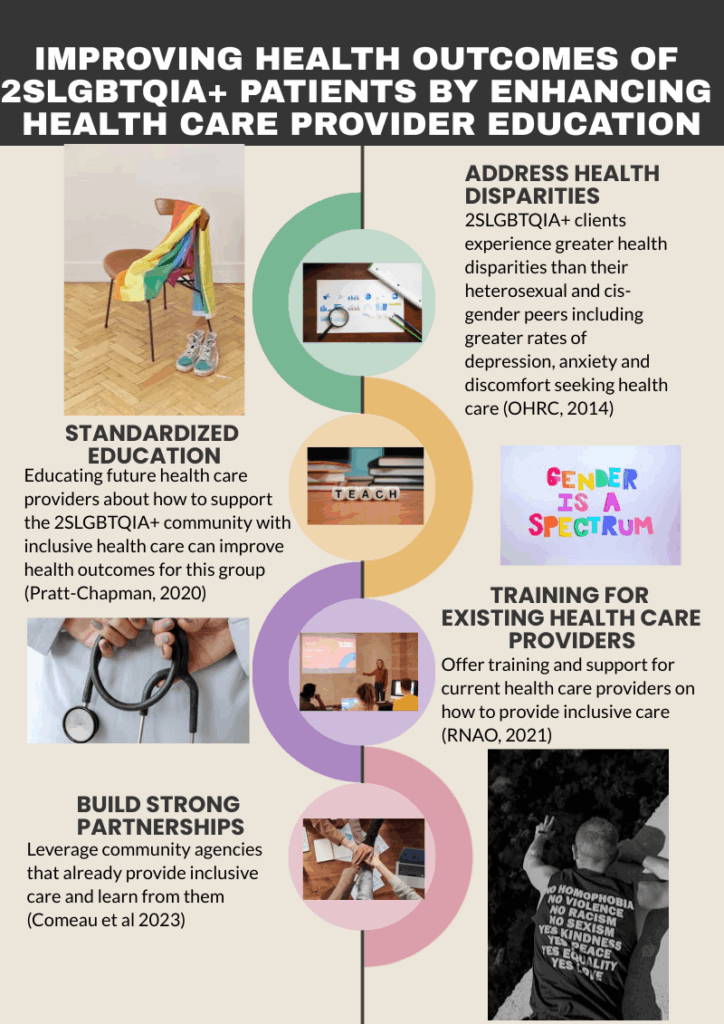
Infographic depicting how quality health care provider education can improve health outcomes for 2SLGBTQIA+ patients
Author: Lindsay Rosien (using Canva)
Date: Oct 19, 2025
In Unit 4 of MHST631, we were tasked with developing a health infographic to clearly show our health problem and proposed solution. I used Canva here and completed the below infographic.
References
Comeau, D., Johnson, C., & Bouhamdani, N. (2023). Review of current 2SLGBTQIA+ inequities in the Canadian health care system. Frontiers in Public Health, 11. https://doi.org/10.3389/fpubh.2023.1183284
Ontario Human Rights Commission (OHRC). (2014). Policy on preventing discrimination because of gender identity and gender expression. https://www3.ohrc.on.ca/en/policy-preventing-discrimination-because-gender-identity-and-gender-expression
Pratt-Chapman, M. L. (2020). Implementation of sexual and gender minority health curricula in health care professional schools: A qualitative study. BMC Medical Education, 20, Article 138. https://doi.org/10.1186/s12909-020-02045-0
Registered Nurses’ Association of Ontario (RNAO). (2021). Promoting 2SLGBTQI+ health equity. https://rnao.ca/bpg/guidelines/promoting-2slgbtqi-health-equity
Summary of the National Collaboration Centre for Indigenous Health
Author: Lindsay Rosien
Date: Nov 17, 2025
In Unit 6 of MHST631 we used the National Collaborating Centre for Determinants of Health summary document (2013) to present details on a health promotion organization. I chose to present information on the National Collaboration Centre for Indigenous Health.
Organization | National Collaboration Centre for Indigenous Health |
URL | |
Area(s) of Focus | A National Indigenous organization established in 2005 by the Government of Canada and funded through the Public Health Agency of Canada to support First Nations, Inuit, and Métis public health renewal and health equity through knowledge translation and exchange. The NCCIH is hosted by the University of Northern BC on the traditional territory of the Lheildli T’enneh in Prince George, BC. |
Relevance to social determinants of health and health equity | Strong – a heavy focus on Indigenous social determinants of health and health equity |
Intended Use | The National Collaborating Centre for Indigenous Health develops, synthesizes, and translates health knowledge and information that is Indigenous-led, meaningful to Indigenous peoples and fosters self-determination and respectful relationships between Indigenous and non-Indigenous health systems. |
Principles/Values | The NCCIH is guided by six overarching principles:
|
Tools/Guides | · Podcast series – ‘Voices from the field’ · Video series – ‘Remaining Visionary’ · Training programs for educators working in Inuit and Metis communities |
Strategies | Supports a renewed public health system in Canada that is inclusive and respectful of First Nations, Inuit and Métis peoples. Uses a holistic, coordinated and strengths-based approach to health and fosters links between evidence, knowledge, practice and policy while advancing self-determination and Indigenous knowledge in support of optimal health and well-being. |
Barriers/Risks | This agency is funded by the Government and Public Health Agency of Canada which may undermine trust in the agency by Indigenous people due to impacts of colonization and colonialism and historic injustices perpetrated by the Canadian Government and health systems. |
Success Factors | Many resources and ways to learn. Visual, auditory and written mediums. Clear vision, mission and values identified. |
Evaluation | Some resources are less community engagment focused and more about larger health and wellbeing topics. Resources are well-referenced and appear professional and well written. |
Other Comments | Website is well laid out and easy to navigate. |