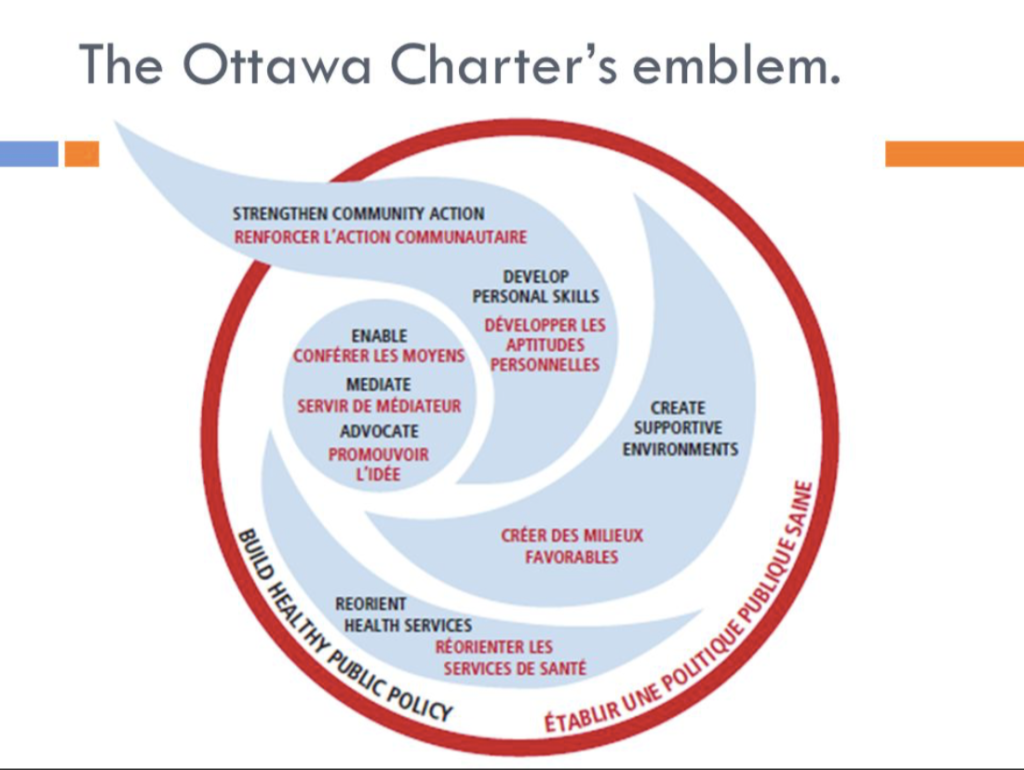
In November of 1986, the Ottawa Charter was developed, a deliverable from the first ever International Conference on Health Promotion. This event occurred in Ottawa, Ontario and was coordinated by the World Health Organization. The Ottawa Charter has played an important role in shaping the way in which health promotion is understood across the world. It was a pivotal step forward for health promotion. Although we have lived with and known the Ottawa Charter in our work, it is important to understand that this document was considered quite radical when it was developed (Potvin & Jones, 2011).
The Charter placed health within the context of everyday life and outlined 3 strategies and 5 action areas. These 5 action areas are:
- Building healthy public policy
- Creating supportive environments
- Strengthening community action
- Developing personal skills
- Reorienting health services
Canadian Context:
In Canada, the 5 action areas became the fundamental pillars of public health work which was a large shift form more traditional medical model health care. The Ottawa Charter highlighted that health was more than just not being sick, but includes the interplay of environmental, social and economic considerations in addition to personal health choices and the absence of disease (WHO, 1986).
Global Context:
The Ottawa Charter has been accepted worldwide as a cornerstone of health promotion and has paved the way for other international frameworks such as the Geneva Charter. Thomas et al, 2025 states that the Ottawa Charter introduced a paradigm shift by asserting that health is created in the settings of everyday life – where people live, learn, work and play.
The Charter has been and still is a very important document as it relates to health promotion, however, it was written almost 40 years ago and it may not be as relevant of current day considerations for that reason. It has been pointed out that the Charter is Western-centric in its view and is not inclusive of Indigenous viewpoints. It does also not speak to equity-deserving groups and the additional barriers faced by these groups as it relates to health (Onyango, 2017).
References:
Onyango J (2017) The Ottawa Charter: The Implications upon Public Health almost 31 Year since its Declaration. J Healthc Commun. 2:54. doi: 10.4172/2472-1654.100095
Potvin, L., & Jones, C. M. (2011). Twenty-five years after the Ottawa Charter: the critical role of health promotion for public health. Canadian journal of public health = Revue canadienne de sante publique, 102(4), 244–248. https://doi.org/10.1007/BF03404041
Thompson, S.R., Watson, M.C. & Tilford, S. (2018). The Ottawa Charter 30 years on: still an important standard for health promotion. International Journal of Health Promotion and Education, 56(2), 73-84. https://www.researchgate.net/profile/Michael-Watson-
22/publication/321988057_The_Ottawa_Charter_30_years_on_still_an_important_standard_for_health_promotion/links/5d5d4fec92851c376370e484/The-Ottawa-Charter-30-years-on-still-an-important-standard-for-health-promotion.pdf
World Health Organization. (1986). Ottawa Charter for Health Promotion. https://iris.who.int/bitstream/handle/10665/349652/WHO-EURO-1986-4044-4380361677-eng.pdf?sequence=1